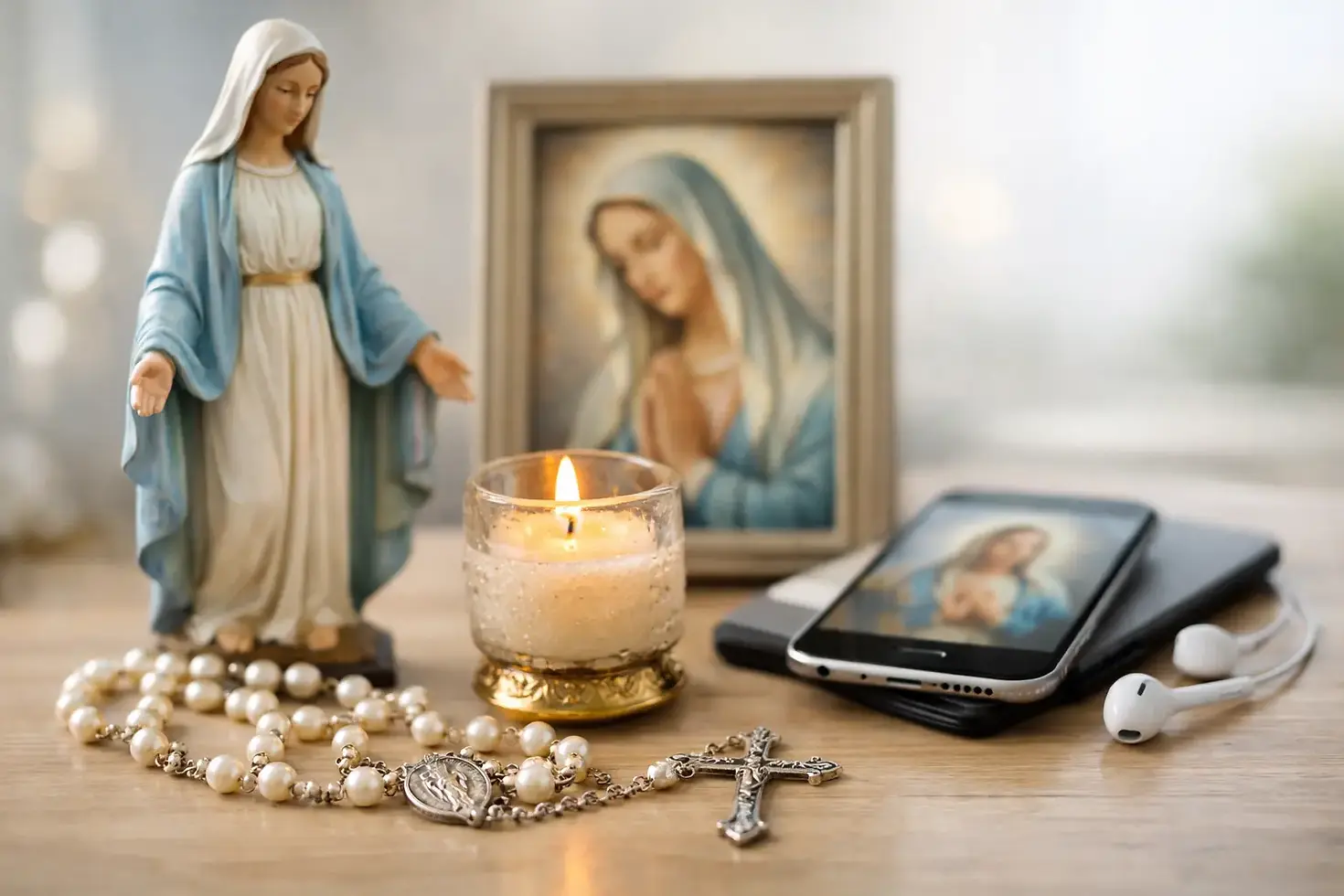
A Guide to Marian Devotional Media

A voice can change the way a soul receives a story. Many Catholics know this by experience: a Rosary prayed slowly in one’s mother tongue, a hymn to Our Lady sung with sincerity, or a faithful retelling of Fatima heard in a quiet room can remain in the heart long after the moment has passed. That is why a guide to Marian devotional media matters. It is not merely about choosing content. It is about choosing what helps you contemplate Mary with greater reverence, trust, and spiritual fruit.
What makes Marian devotional media worth seeking
Not all religious media serves the same purpose. Some material is informational, some is artistic, and some is truly devotional. Marian devotional media should do more than mention the Blessed Virgin Mary. It should lead the listener, reader, or viewer toward a deeper love of Christ through His Mother.
For many Catholics, this kind of media becomes part of daily spiritual life. An audiobook can accompany a commute and turn ordinary time into prayerful recollection. An eBook can support a holy hour, a family reading routine, or a season of Marian consecration. Sacred storytelling can help children, parents, and grandparents stand on common ground, receiving the same truths in language that reaches the heart.
There is also a pastoral reason to choose carefully. Marian devotion is tender terrain. If the tone is sentimental without substance, it fades quickly. If it is factual but spiritually cold, it may inform without moving the soul. The best devotional media holds together fidelity, beauty, and accessibility.
A guide to Marian devotional media for different needs
The right choice depends on what you are seeking in this season. Some Catholics want quiet personal prayer. Others need trustworthy resources for classrooms, parish groups, or family formation. The medium matters because each format shapes attention differently.
Audiobooks for prayerful listening
Audiobooks are especially powerful when Marian devotion is tied to contemplation and memory. Hearing the story of the Mother of God spoken aloud can feel closer to the Church’s oldest way of handing on the faith, where truths were received not only from the page but also through the human voice.
For devotional listening, narration matters more than many people expect. A rushed or theatrical voice can distract from prayer. A reverent, clear narration invites the soul to listen without strain. This is even more significant for multilingual audiences. Catholics often encounter Our Lady most intimately through the language in which they first learned to pray. Native-speaker narration can bring warmth, dignity, and spiritual closeness that a merely functional translation may not.
Audiobooks are a strong choice for those who are busy, visually fatigued, elderly, or simply more receptive through hearing than reading. The trade-off is that audio is less suited for underlining, citation, or study. If your goal is meditation and spiritual companionship, audio often excels. If your goal is close textual analysis, another format may serve better.
eBooks for slow reading and reflection
An eBook offers a different grace. It gives the reader the power to pause, return, highlight, and pray with a passage in silence. Marian texts often deserve that kind of patient attention, especially when they involve Scripture, apparitions recognized by the Church, or the interior dimensions of Mary’s fiat, sorrow, and maternal love.
eBooks can be especially helpful for homeschool families, adult faith formation, and personal devotional reading during liturgical seasons such as Advent, Lent, and May devotions. They are also practical for global Catholic audiences, since digital access allows believers in many regions to receive faithful content without the delay or cost of print shipping.
Still, eBooks ask for focus. If a reader already feels overburdened by screens, digital reading may not feel restful. In that case, pairing an eBook with audio can be a wise solution, allowing both study and contemplative listening.
Music and dramatic storytelling for communal devotion
Some Marian media is meant not only to be consumed but shared. Music, dramatic works, and devotional storytelling can animate parish missions, school programs, feast day events, and family gatherings in ways that solitary reading cannot.
This form of media has a particular strength: it allows doctrine and devotion to be embodied. When the story of Fatima, for example, is sung, spoken, and enacted, it can become newly vivid for people who would not normally sit down with a theological text. This does not make dramatic media less serious. In faithful hands, it can become a form of catechesis touched by beauty.
The discernment here is simple but important. Artistic power should never come at the expense of reverence or truth. A moving performance can open hearts, but the content must remain rooted in the Church’s understanding of Mary and the spiritual gravity of the events being portrayed.
How to judge whether Marian media is faithful
Catholic audiences are right to be discerning. Beautiful packaging alone does not guarantee trustworthy content. A true guide to Marian devotional media must include the question of fidelity.
Begin with the portrayal of Mary herself. Does the work present her in harmony with Scripture and Catholic tradition? Does it honor her maternal role without exaggeration or distortion? Strong Marian media never places Our Lady apart from Christ. It reveals her as the humble handmaid of the Lord, the Mother given to the Church, and the one who always leads souls to her Son.
Next, consider historical grounding. This is especially important in works dealing with approved apparitions, sacred history, or devotional narratives that claim to educate as well as inspire. Artistic adaptation has its place, but it should not confuse invention with doctrine. Faithful media knows the difference between devotional imagination and what the Church actually teaches.
Then look at tone. Reverence is not stiffness, and emotional warmth is not sentimentality. The strongest Catholic media speaks with tenderness and conviction. It avoids irreverence, novelty for its own sake, and sensational treatment of holy things.
Finally, ask whether the work bears the marks of care. Quality narration, thoughtful translation, serious writing, and artistic craftsmanship all matter because devotional media forms attention. Sloppiness interrupts prayer. Beauty, when honestly offered, can dispose the heart toward contemplation.
Why language and culture matter in Marian devotion
Mary is truly One Mother to all Her children. For that reason, Marian media should not feel confined to a single culture even when it is rooted in one. The Catholic Church is universal, and Marian devotion often becomes most intimate when it is heard in the cadence of one’s own people.
This is not just a marketing consideration. It is pastoral. A grandmother praying in Spanish, a family listening in Tagalog, a student reflecting in French, or a parishioner hearing a Marian narrative in Portuguese may receive the same truth with greater immediacy because the language reaches memory, affection, and trust.
At its best, multilingual devotional media does something quietly profound. It tells the faithful across nations that they are not an afterthought. They are addressed as beloved children of the Church. When native-speaker narration and culturally attentive presentation are present, the result is often more than convenience. It becomes an act of welcome.
This is one reason mission-driven Catholic media deserves attention. When artistic work is created with devotional seriousness and international accessibility, it serves both evangelization and consolation. In that spirit, Mother of God Studios has offered Marian storytelling in multiple languages with a reverent commitment to both beauty and fidelity.
Choosing media for home, parish, and school
The best Marian devotional media is not always the same for every setting. For private prayer, many Catholics benefit most from audio and reflective reading. For family life, narrative clarity matters, especially when children and adults are listening together. For parishes and schools, the question expands to include usability. Can this resource support a group setting? Is it spiritually sound for mixed ages? Does it invite participation without losing reverence?
Parish leaders and educators often need material that can bridge devotion and formation. A dramatic work or devotional story may succeed where a lecture does not, especially if it gives people an emotional entrance into the mystery before leading them toward deeper understanding. At the same time, what works in a theater or classroom may not be ideal for personal prayer before bed. Matching the format to the setting is not a compromise. It is wise stewardship.
A practical rule helps here: choose media according to the fruit you are seeking. If you want recollection, choose something quiet and contemplative. If you want family engagement, choose something narratively strong and accessible. If you want parish participation, choose resources designed for communal use and faithful presentation.
Let devotion shape the choice
Catholics do not seek Marian media only to be informed or entertained. We seek it because we want to love Our Lady more faithfully, and through her, belong more completely to Jesus. That is the real measure. The right media deepens trust, steadies prayer, and leaves behind not noise but peace.
When choosing what to hear, read, or share, do not ask only whether it is polished. Ask whether it is prayerful. Ask whether it is true. Ask whether it speaks with the kind of beauty that helps the soul listen. If it does, then even a simple recording, a humble eBook, or a reverent song can become a small place of encounter where the Blessed Mother gently leads another heart toward her Son.
And if your next step is small, let it still be sincere. A single faithful story received with love can do more for devotion than a shelf full of distractions.


Comments